
The name is about writing.
A trained model is effectively read-only: the weights freeze when training ends, and whatever it works out while you are talking to it lives in a context window that gets thrown out with the session.
I'm Rob Cobbins. I started Axiogram Labs to work on machine learning systems that hold a state of their own.
First principles of stateful machine learning
Most of what the field calls memory is a longer window, a database bolted to the side, or another training run. The work here is on models that are genuinely writeable at inference time: they carry a state of their own, write to it as they run, and keep what they wrote. Four things follow, and they are why it is worth the trouble.
The state is bounded and stays that way whether the model has been running a minute or a month. Nothing replays the interaction history on each request.
What it works out from you is written into the state and is still there after the session ends.
A process that stays up and carries its state across invocations.
A bounded state cannot keep every observation verbatim, so consolidation, forgetting, and what happens when a new write contradicts an old one become architectural questions.
The alternatives
Three things get called memory: retrieval over a document store, compression of a transcript to fit more of it in, and fine-tuning on the side. Each leaves the model itself read-only and puts the memory somewhere else. The research here concerns a bounded state that participates directly in the computation and stays writeable while the model runs. Where that sits relative to recurrent state, fast weights and online adaptation is part of the technical work, and the papers will say so precisely.
| Property | Long context | Retrieval | Continual fine-tuning | Writable internal state |
|---|---|---|---|---|
| Where the information lives | Context window | External store | Updated weights | Inside model state |
| How it gets updated | Append tokens | Write to the store | Gradient steps | The model writes it |
| Bounded without replaying the history | No | Partly | Yes | The target |
| Survives the session | Not inherently | Yes | Yes | Yes |
| Takes part in the computation | Yes, as prompt tokens | Only once retrieved | Implicitly, in weights | Yes, as state |
Whether a fixed-parameter computation can do open-ended work over a bounded state it continuously reads and rewrites remains open. Some of it works with no training at all. Some works only after training. Some does not work yet. The logbook records which and why, and that is what the first papers are about.
Why ownership matters past privacy
A stateless model you run locally is the same model on your last day with it as on your first. One that accumulates on your hardware, from your data, becomes specific to your problems without any of that history leaving the machine. Bounded state is also what makes the cost of running one predictable, and predictable cost is what makes consumer hardware a realistic place to put it.
What the second line is for
Interpretability is how you test whether an architecture is doing what its behavior suggests, so the two lines answer to each other. It runs on public weights: forty-six models across fourteen families, 0.16B to 14B. A lot of published work covers one model against a friendly baseline and stops there.
RWKV, Mamba, Falcon-H1 and recurrentgemma are all in the panel, which is the same architecture class the first line is about, and that is why they are there. The two lines are one question asked from both ends. The latent-reasoning capacity boundary holds across fourteen models from 28 to 48 layers and an SSM hybrid alike, which puts it below the attention mechanism, in the computation itself. Commit-then-transport holds on a model with no attention layers at all.
What has come out of it so far is a calibration of how far to trust the existing literature, and it runs in both directions. The measured results are on their own page, along with the ones that cut against the thesis.
The divider
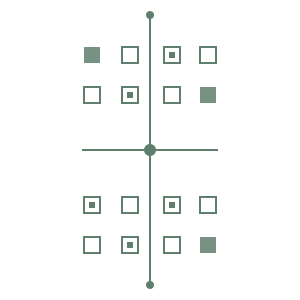
The mark between axio and gram is a vertical spine crossed by a horizontal, with cells scattered either side, some filled and some empty. The spine is the state that persists; the cells are what has been written and what has not. It is the architecture, at the size of a piece of punctuation.
Background
I've spent seventeen years in security and identity infrastructure as a sales engineer, which is the side of the industry where you find out what production actually looks like. I came to machine learning without a lab, which is why the logbook starts at chapter one.
Contact
Research and collaboration: [email protected]
General inquiries: [email protected]